Concept case study · 2025

Firstword

When software breaks, your customers should hear it from you first.

One board that finds which customers an outage hits, drafts the first message for a person to approve, replays the night minute by minute and keeps the record. From research to a coded prototype on web and iPhone.

Role
Design, data viz, front end
Platforms
Web and iPhone
Built with
Next.js, React, TypeScript

Concept prototype · sample data

The story in six lines

  1. GoalLet customer teams tell affected customers about an outage before the customers find out.
  2. ProblemEngineers watch errors by service; customer teams watch accounts. Neither can answer “am I affected?”, go to this part
  3. ApproachJoin incident data to accounts, show who is hit and how hard on one board, and let AI draft the first note., go to this part
  4. DecisionThree bars and a line of evidence, over a percentage score: 87% looks precise and stops people reading why., go to this part
  5. LaunchA concept, from research to a coded prototype on web and iPhone: five views, a minute by minute replay and a log of every incident., go to this part
  6. ResultWhat I’d measure: the share of affected customers who hear from you before they contact you., go to this part

Select a line to read that part.
How it works

One outage, from the first error to the last note

Recorded from the working prototype, in five steps.

  1. Watch the incident unfold

    Five moments of one outage, on one sheet. Hover a moment to hold it.

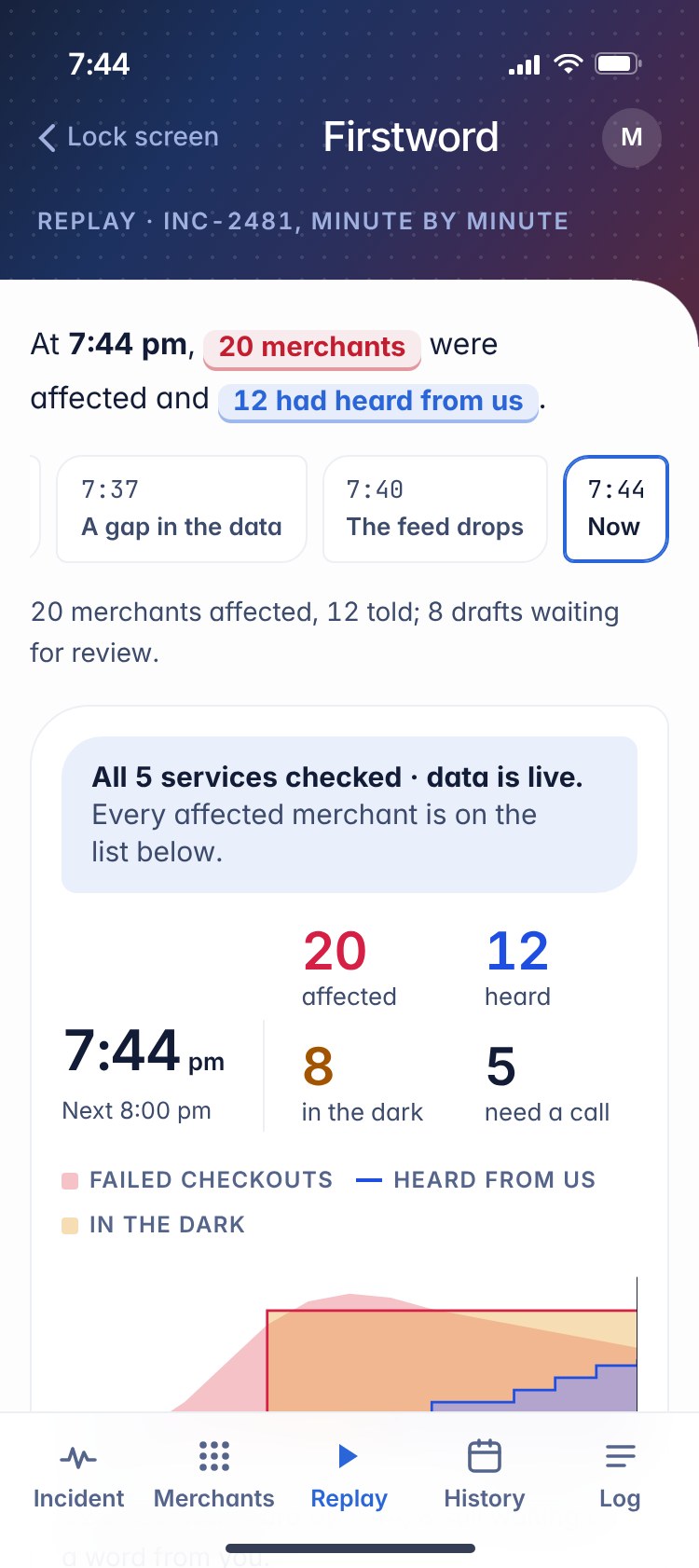
    The replay: a stepper of five moments on the left, from All quiet to Now; beside it the alert, the clock with four numbers and the timeline hold the same place as the pointer moves down, and the notes sent by that minute fill the list on the right.
  2. See who is affected, and how much

    Every merchant by failure and stakes, colored by severity. Pick one to open its note.

    The blast radius chart: merchants as bubbles by share of orders failing and orders an hour, ember for critical, lighter for major and minor. The pointer selects La Panadería, which gets a ring, and its draft slides in from the right.
  3. Approve the first word

    The draft shows its sources; a person approves and sends.

    La Panadería’s draft opens in a panel with a dark head: the merchant, its share failing, the channel; below, the draft itself, its sources and a high confidence. The pointer selects Approve and send to Lucía, and the note is marked approved by Maya at 7:44 pm.
  4. Close the loop

    Who has heard from you, and who is still waiting.

    The thread of telling: nine strands run from Firstword to merchants; green ones were read, blue delivered, dashed ones are drafts still waiting. The pointer lights a strand and opens its merchant, then selects 9 unsent, review drafts.
  5. Keep the record

    Every incident since the first night: the trend, the log, and a postmortem that writes itself.

    The Log: a period selector, five numbers against the period before, incidents per month stacked by level, time to first word as dots with a rolling median falling from about 24 minutes to 6, and the incident log below. The pointer picks a month, then opens tonight’s row.

On the phone

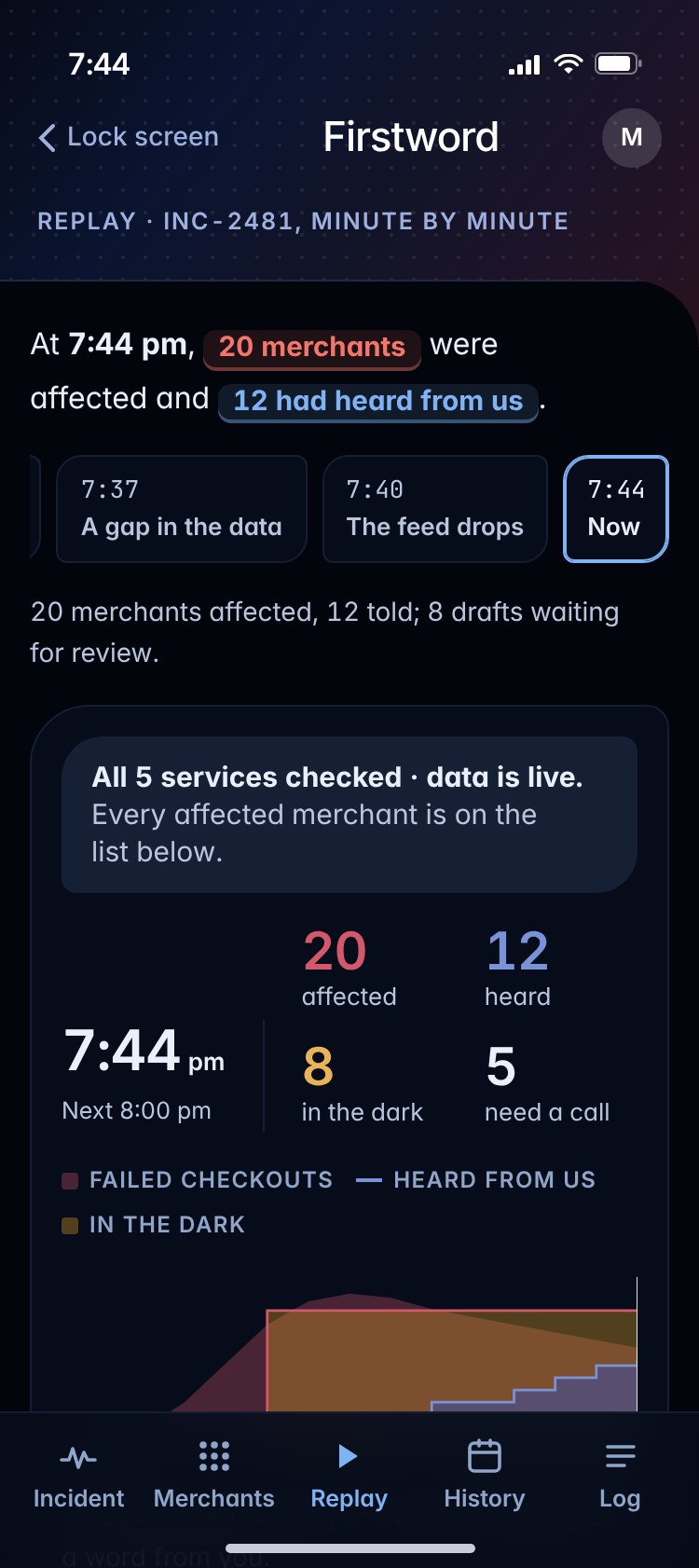
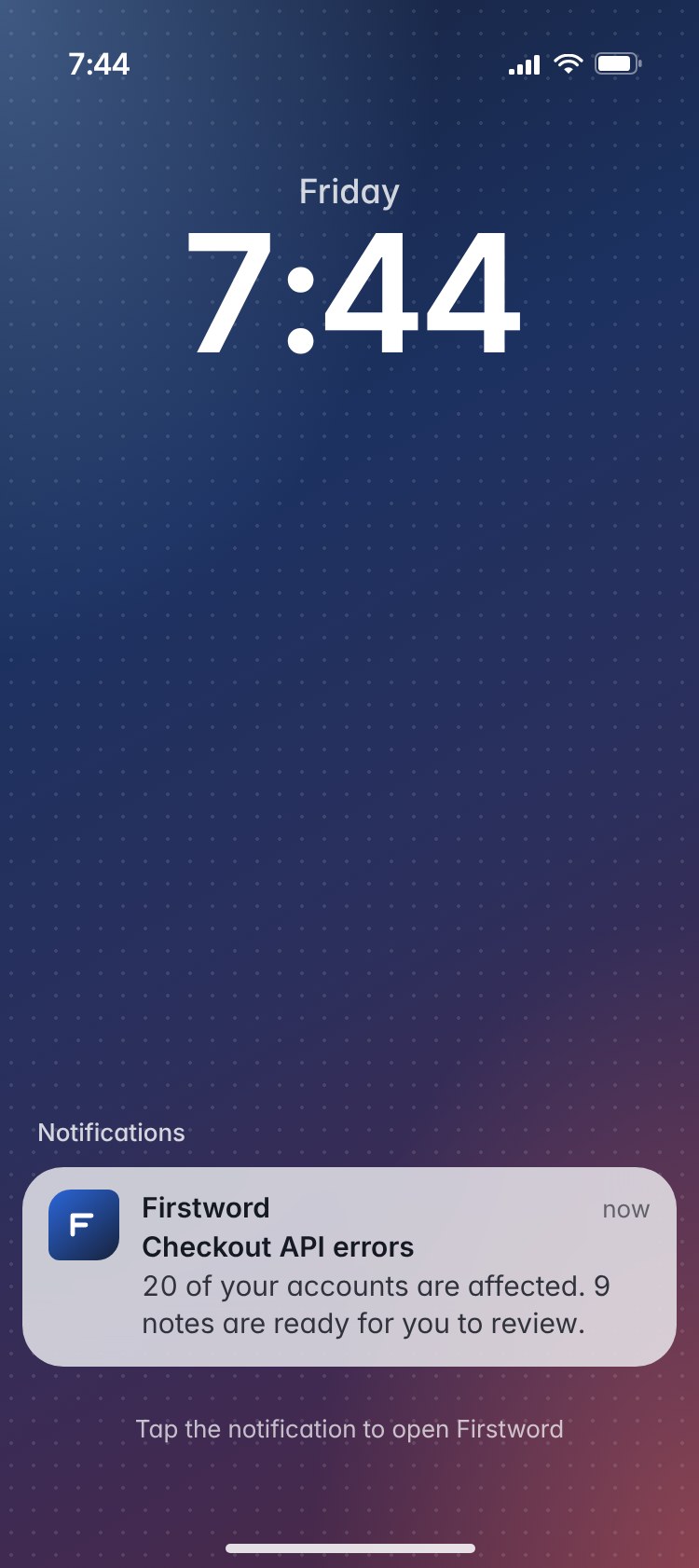
From the lock screen to sent, and the whole board in her pocket

An account manager away from her desk can still send the first word, and still open the replay, the history and the log. Every chart answers to a finger: tap for the story, tap again to go.

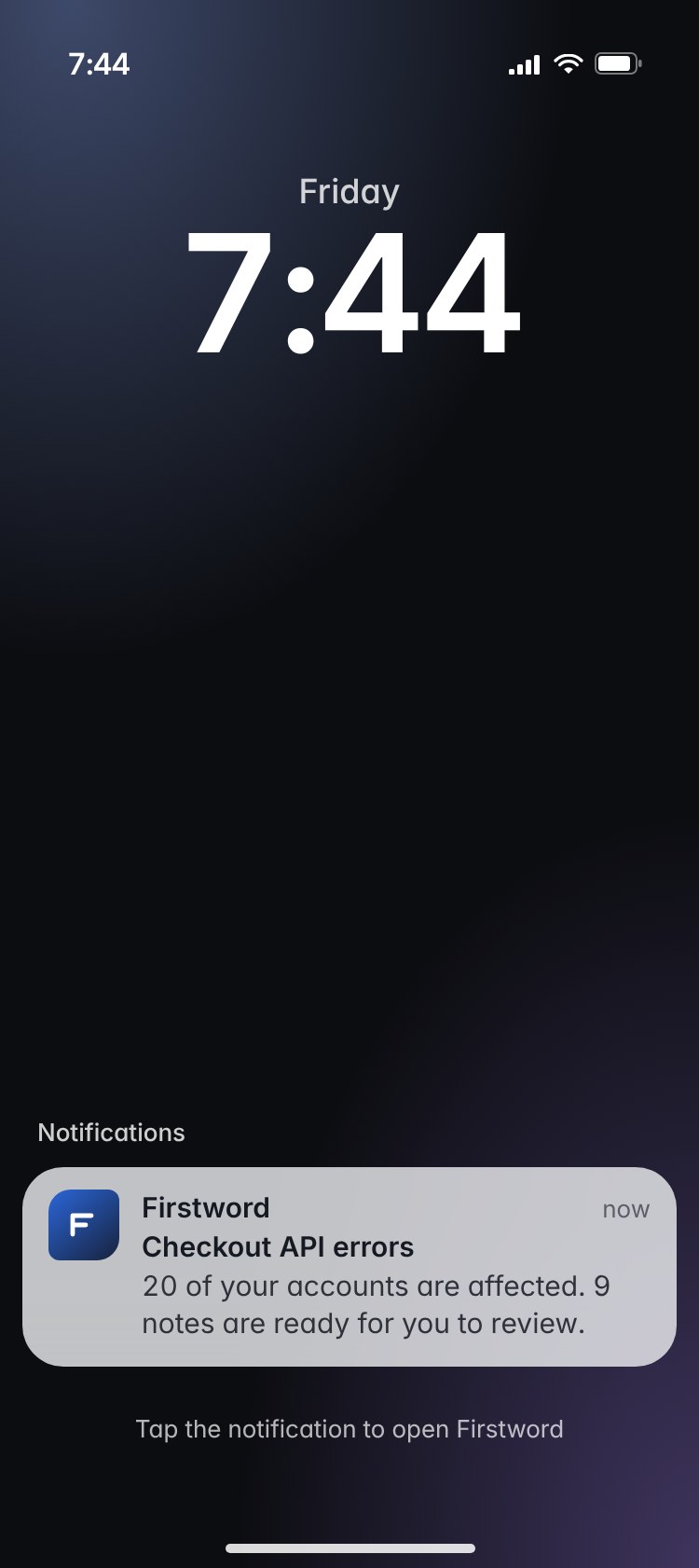
  1. 01 · Lock screen

    20 accounts affected, 9 notes ready.

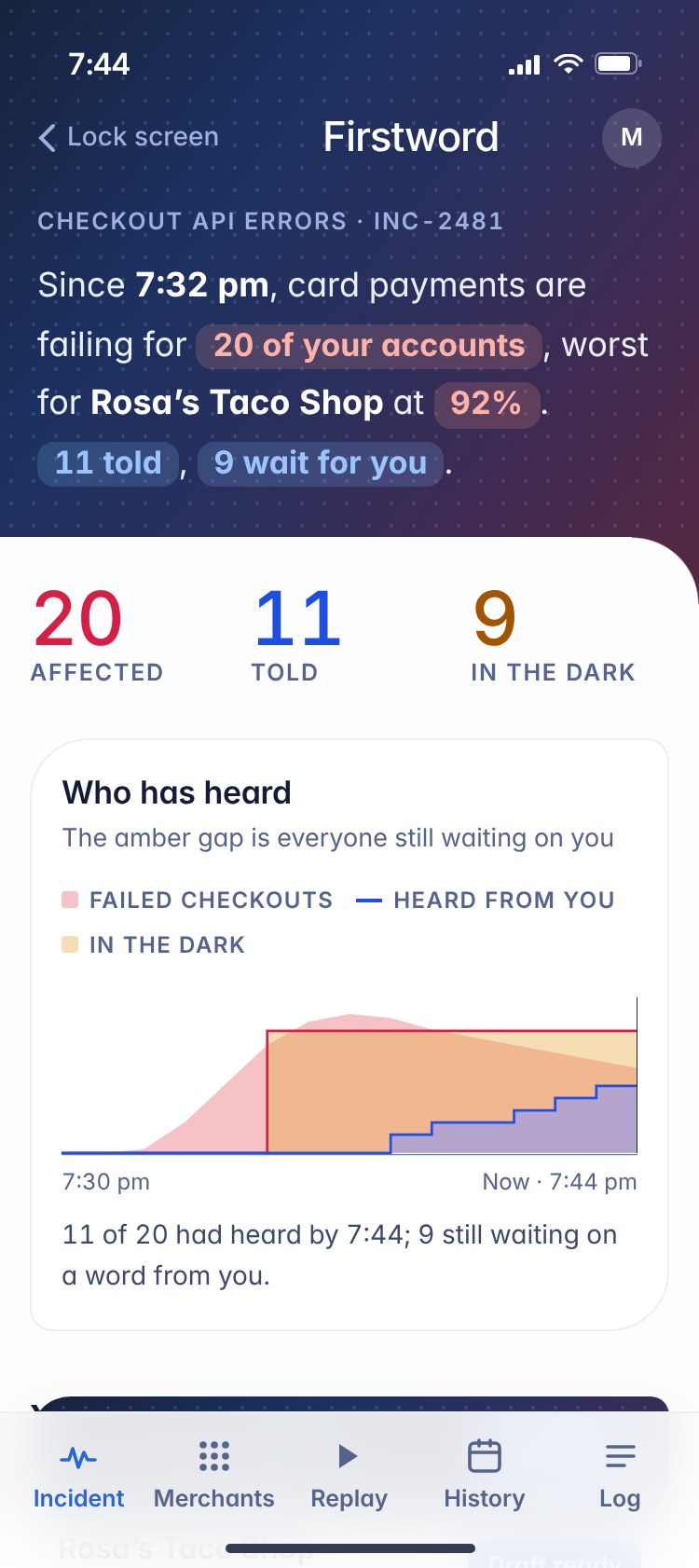
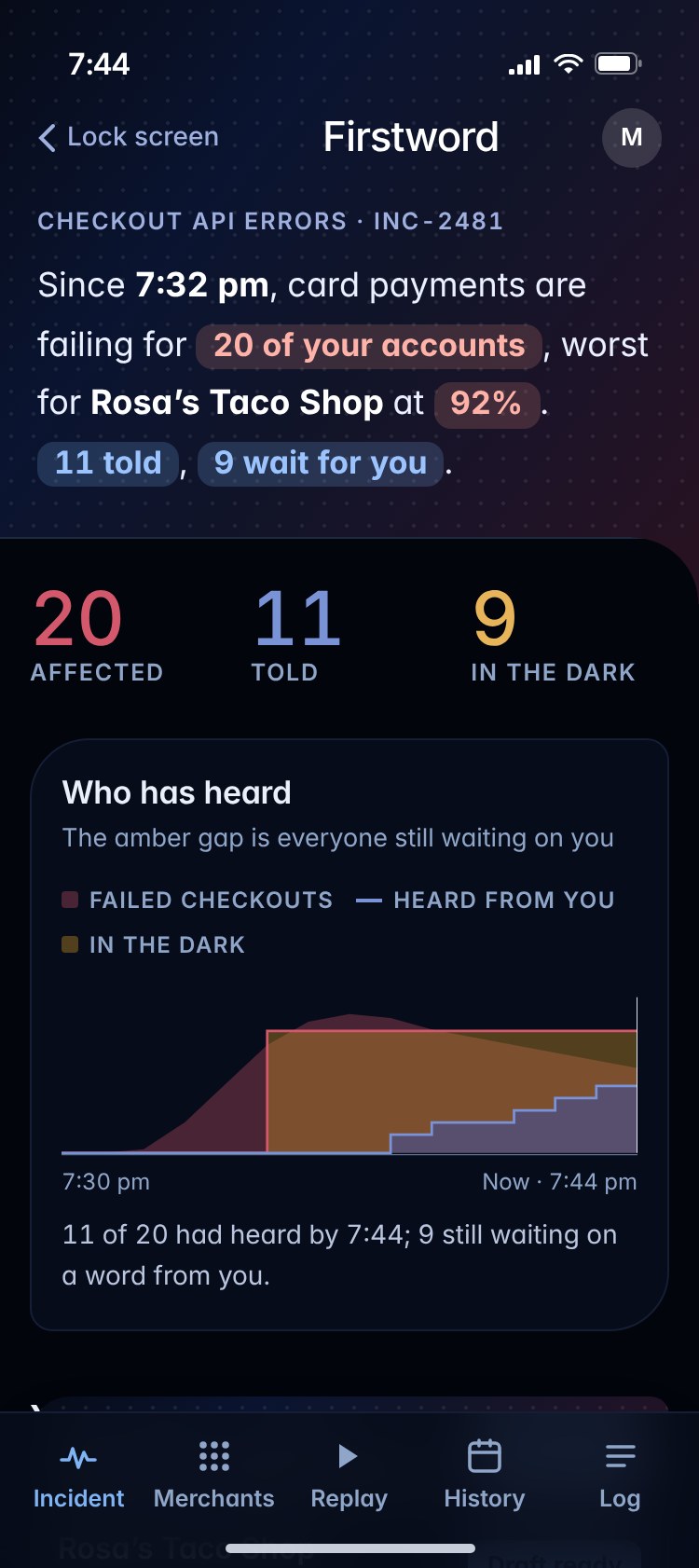
  2. 02 · The incident

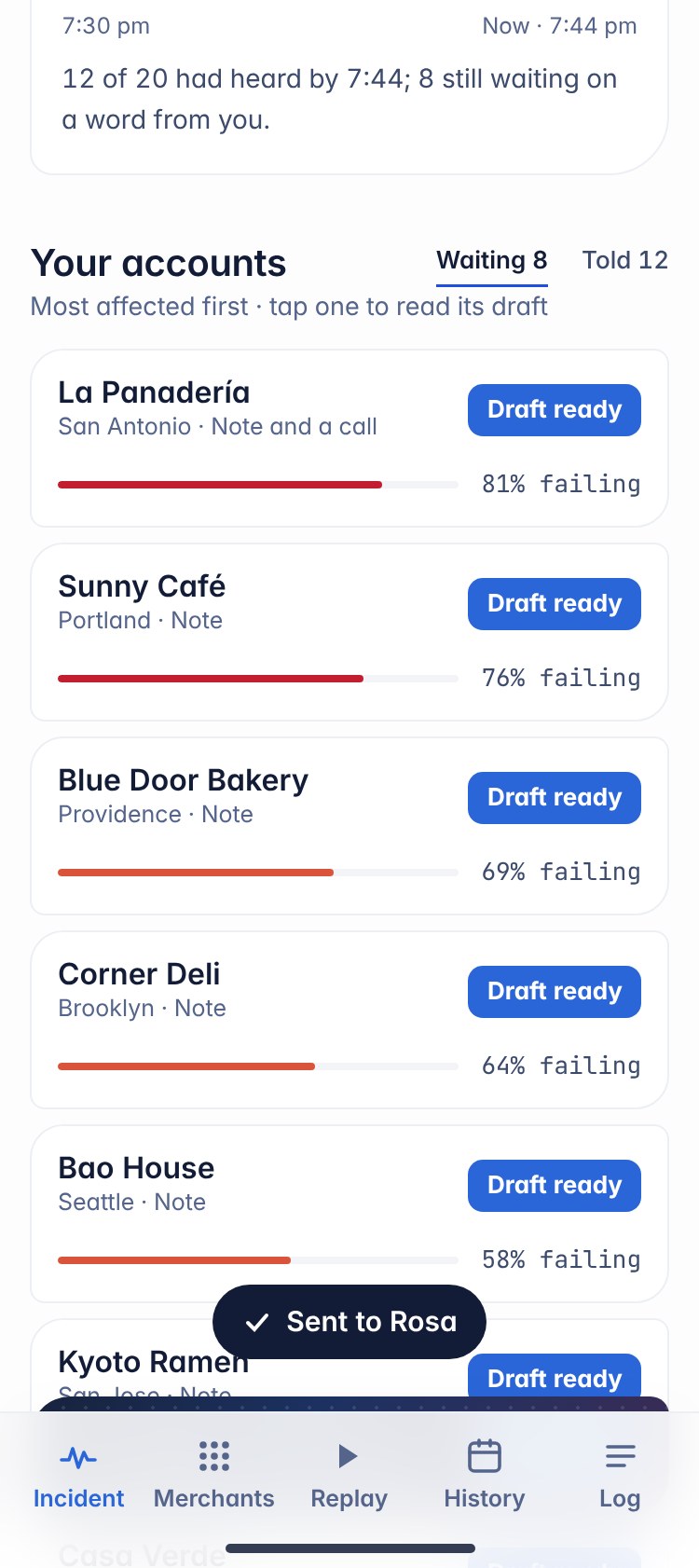
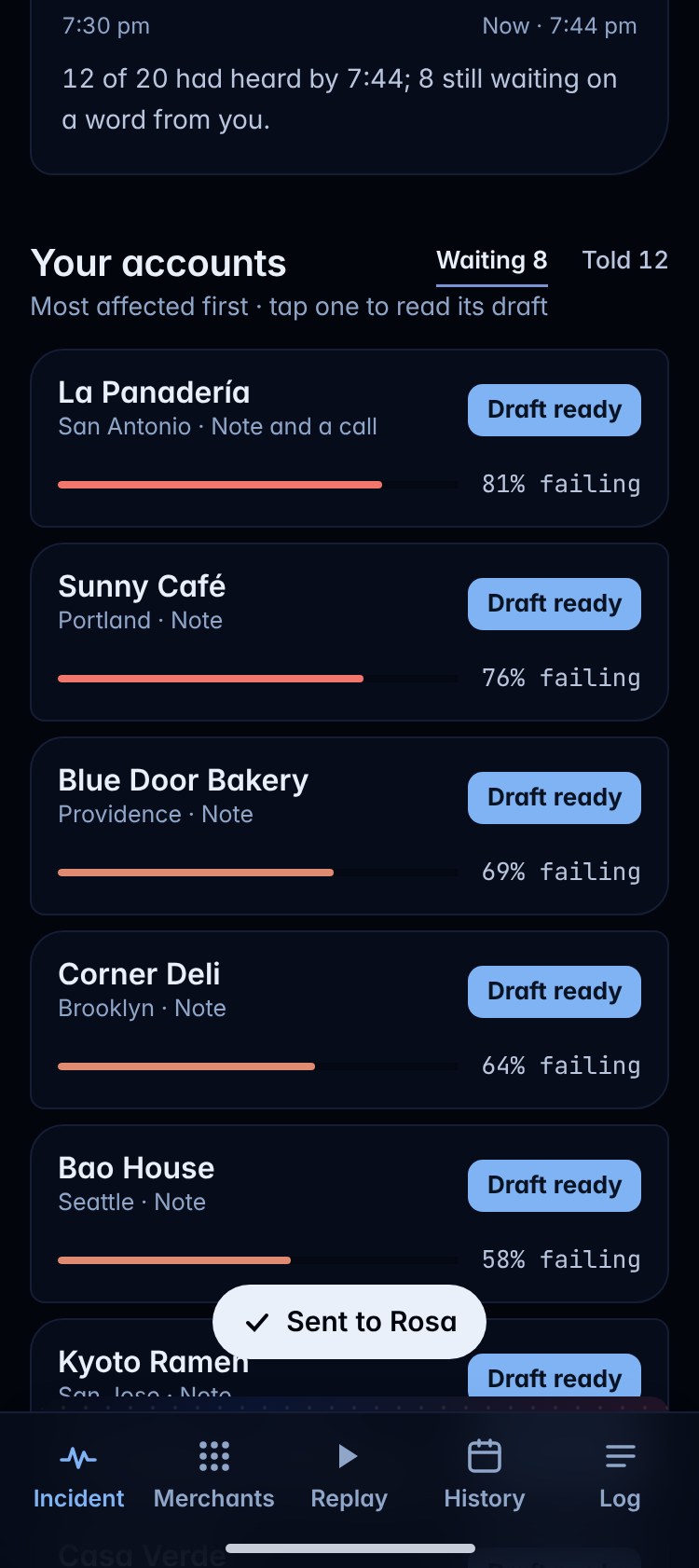
    The night in one sentence, who has heard, and her accounts most affected first.

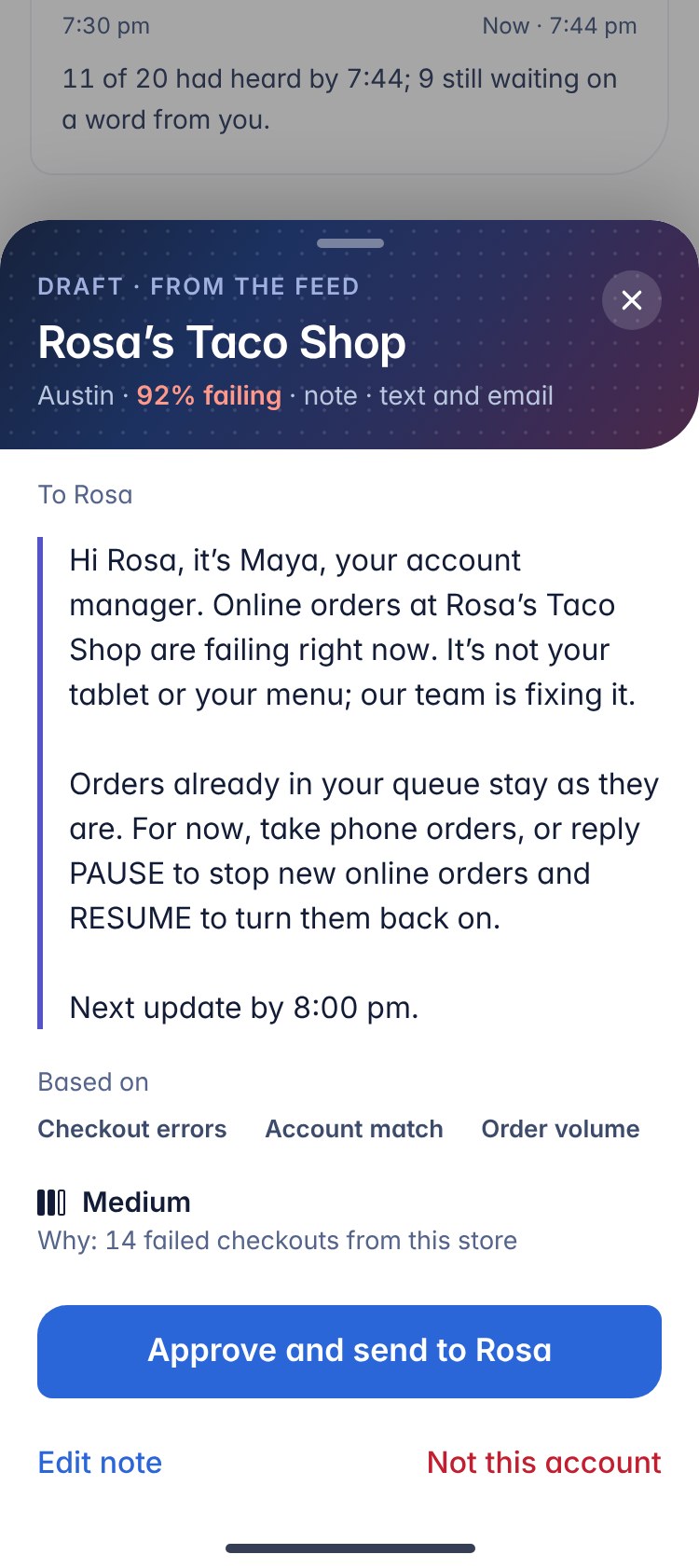
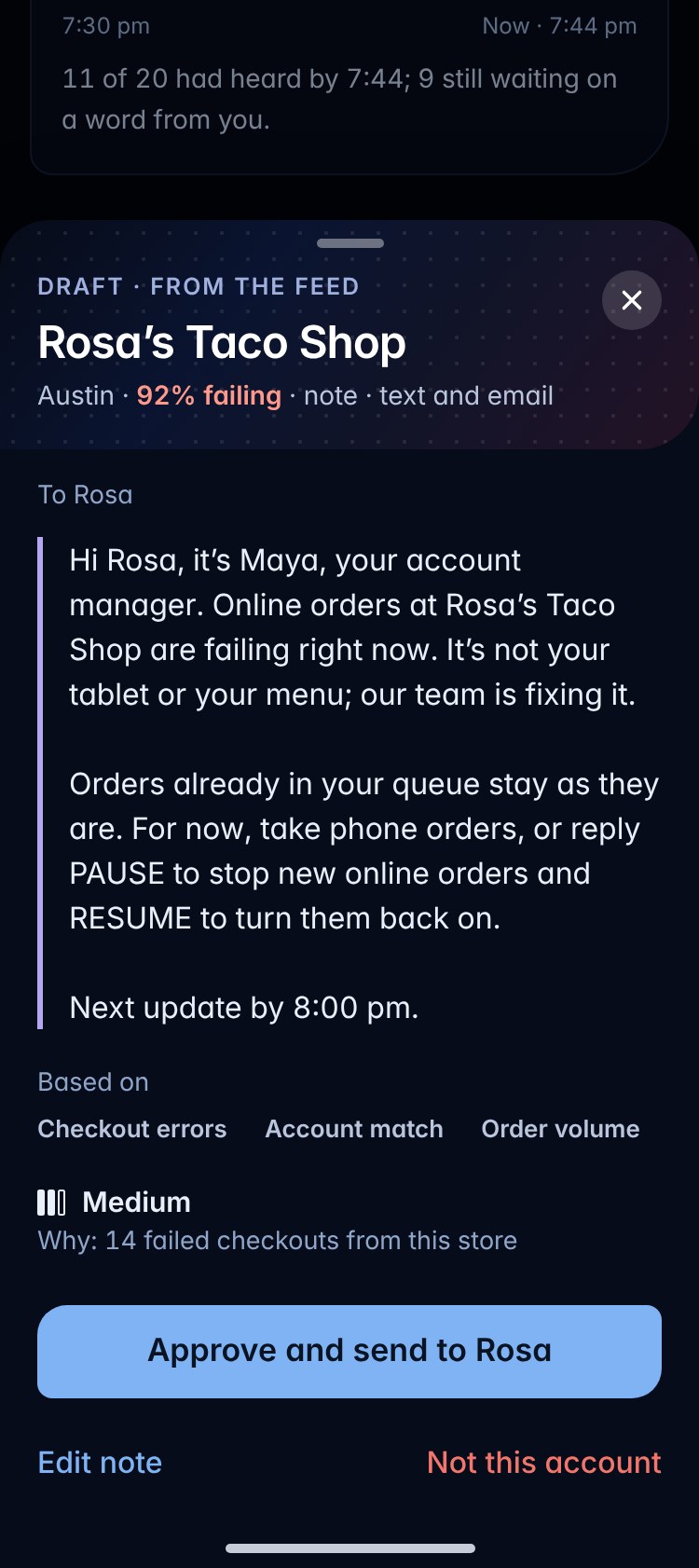
  3. 03 · The draft

    She checks the draft’s sources and approves.

  4. 04 · Sent

    Sent under her name. Waiting drops to 8, and told rises to 12.

  5. 05 · The whole board

    Merchants, the replay, history and the log, in tabs, for a finger.

  6. 06 · All of it, in motion

    The recording: from opening Firstword to a sent note, then into the replay.

01 · The problem

Two views that never meet

Engineers watch errors by service. Customer teams watch accounts. During an outage neither can answer the one question a customer asks: am I affected?

So the apology starts late.

What engineers see

  • checkout-api4.2% errors
  • ordering1.1% errors
  • payments0.8% errors
  • menushealthy

What customer teams see

  • Big Slice PizzaEnterprise
  • Rosa’s Taco ShopStarter
  • Sunny CaféStarter
  • Harbor GrillEnterprise

Nobody can see which customers are affected.

02 · Research

The gap isn’t data. It’s the join.

Public postmortems, status pages and forums, then simulated interviews to test the guide.

Real interviews are next.

  1. 1The first signal is an angry customer.Then teams hunt through chat.
  2. 2Only some services carry a customer ID.So matches show confidence and ask for checks.
  3. 3People trust a reason more than a score.So every match explains itself in one line.

03 · The idea

Who is affected, how much, and what is at stake

Two axes, failure and stakes, so big accounts can’t crowd out a small shop losing every order.

Everyone past the first line gets a note. The busiest also get a call.

Blast radius

Past the amber line, a call goes with the note · click a bubble to reviewtap a bubble, tap again to review

critical ›75%major ›40%minorsize = orders / hrcall line
0%25%50%75%100%4080120SHARE OF ORDERS FAILING →ORDERS / HR →

Sunny Café: 76% of orders failing, about 9 orders an hour. Every bubble is a button.

04 · AI with a human in charge

AI suggests, people decide

AI drafts; a person approves. Every draft shows its sources, and the button names who receives it.

I dropped a percentage: 87% looks precise and stops people reading the reason.

Behind the draft

Checkout errorsAccount matchOrder volume
Match confidence: MediumWhy: 14 failed checkouts from this store
An AI draft to Rosa, written the way Maya would say it: marked as a draft, with its sources, its confidence and a button that names who receives it.

Dropped

87%

Looks exact, isn’t. People stop reading the reason once they see a number.

Chosen

Match confidence: High
Match confidence: Medium
Match confidence: LowWhy: Matched by store name only

Three levels plus one line of evidence. Neutral ink, so it never reads as severity.

05 · Edge states

Designed for the gaps first

AI products break at the edges, so I designed those before the happy path. Each state says what is known, what isn’t, and what to do next.

Nothing affected yet

Says what it is watching and when it last checked, so silence never looks broken.

All 5 services reporting. Nothing unusual · last checked 7:30 pm.

Still matching

Shows the partial list, marked as one that may grow, with progress by service.

Still matching accounts. 16 found so far; the list may grow.

3 of 5 services checked

Can’t link to accounts

Names the service with no customer ID and asks engineering, instead of guessing.

Can’t tell which accounts the payments errors hit. The payments service sends no customer ID, so up to 6 more merchants may be affected. Firstword won’t guess.

Data out of date

Pauses sending, so no customer gets a note built on old facts.

Last update 6 min ago · reconnecting. Sending is paused until data is fresh, so no one gets a note built on old facts.

06 · Closing the loop

Who has been told, and who hasn’t

Every affected merchant is a strand from Firstword: green once read, blue once delivered, dashed while a draft still waits.

Hover a strand to light it. The unsent ones lead straight to the drafts.

The thread of telling

Mend the threads · hover a strand to light it, click to opentap a strand to light it, tap again to open

readdeliveredunsent
FIRSTWORDreadreaddlvrddlvrddraftdraftdraftdraftdraft

Green strands were read, blue were delivered, dashed ones are drafts still waiting. The same chart sits on the board.

07 · The story for buyers

Your customers will hear about an outage. The only question is who tells them.

The pitch, written for a skeptical head of customer experience.

Firstword · concept marketing section

Be the first word, not the last to know.

Firstword shows your customer teams which customers an outage affects and how much, then drafts the first message for a person to approve.

  1. 01 · Where trust breaks

    Trust breaks before anyone says a word

    Doubt starts when customers notice first and hear from a status page, not a person.

    The first word comes from their account manager, within minutes.

  2. 02 · Fix it, or soothe it

    We remove the cause, not just the worry

    A nicer status page soothes. Firstword fixes the cause: it joins errors to accounts.

    Reassurance only where it is true (“it’s not your tablet”); everywhere else, the fix.

  3. 03 · Why it’s done this way

    Built around why you’re careful today

    Incident messages are slow for good reasons: early facts are often wrong.

    A named person approves every note, and sending pauses on stale data.

04 · Ask us the hard questions

Push back. Here is what we would say.

The number we would ask you to judge us on: the share of affected customers who hear from you before they contact you.

Why not just use our status page?

Keep it. But it tells everyone the same thing, and waits to be found.

What if the AI matches the wrong account?

Every match shows why. Low confidence needs a person’s check.

Who is responsible for what gets sent?

Your team. Firstword drafts; a named person approves.

What does it need from our systems?

Telemetry with a customer ID. Gaps are shown, not guessed.

08 · Next

What I’d test first, and how I’d measure it

  • Does the blast radius match reality?

    Flagged against the postmortem list.

  • Do people trust the drafts?

    Approved without edits, and time to first message.

  • Does the loop close?

    Affected merchants told, and read, within the first hour.

Built in code

CSS tokens feed light and dark; every text color passes WCAG AA, and nothing on the board is set smaller than 10 point. White paper, azure for the tool’s hand, ember only for severity, green for done.

No outside design system: Firstword runs on a small one of its own. Tokens for color, type and corner radius are scoped to the app and tuned separately for light and dark; every card carries one deep corner, and the dark blocks share a night ramp with a dot grain. Inter sets the text and JetBrains Mono the times and incident IDs. The phone follows Apple’s iOS patterns, like sheets and the system font, and every control is built here, with no UI library.

  • Inktext16.9 : 1 light
    17.0 : 1 dark
  • Azurethe tool’s hand5.2 : 1 light
    9.0 : 1 dark
  • Emberseverity6.0 : 1 light
    7.0 : 1 dark
  • Amberwaiting5.5 : 1 light
    10.3 : 1 dark
  • Greendone5.3 : 1 light
    10.1 : 1 dark

Contrast against the card surface. Switch the site to dark mode and every visual on this page follows.

See it work.

Approve a note at a desk or on the way home, then replay the night. Next: real interviews.